
Best WHS Software Australia (2026)
Compare leading WHS software providers in Australia.

.jpg)
- Match WHS software to your actual risk: plant, incidents, contractors, or psychosocial hazards
- Most platforms bolt psychosocial hazards on rather than treating them as ongoing compliance
- Check whether hazard identification links to a documented control and review cycle
- Shortlist two or three platforms and run a pilot before committing

Download our guide to managing your teams mental health
The best WHS software depends on where your compliance risk actually sits, plant, incidents, contractors, or psychosocial hazards. Below is a quick summary table, followed by a closer look at where each platform fits.
At a glanceWHS needs vary by where your risk sits, so this list covers eight platforms, each with a different focus. SafetyCulture is the strongest general pick for inspections, audits and training. Foremind stands out for psychosocial hazard compliance, with an in-house EAP built in.
Foremind: good for psychosocial hazard and mental health compliance
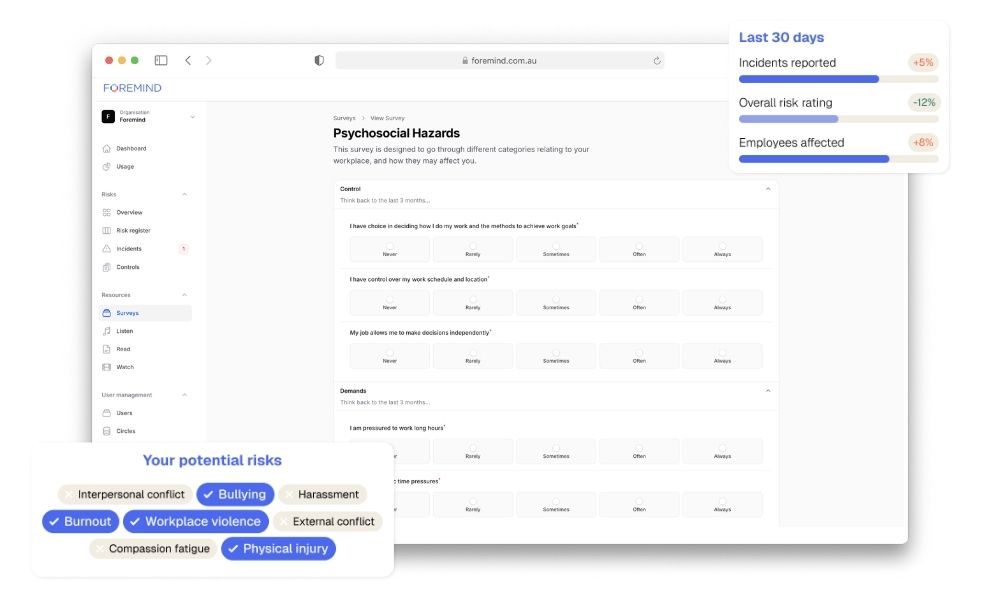
Foremind is the strongest choice for organisations whose primary WHS exposure is psychosocial risk rather than plant or physical hazards. It is the only platform here that connects psychosocial risk assessment, incident reporting and an in-house employee assistance program in one system, so a flagged hazard can lead to a booked counselling session the same day.
Most WHS platforms treat psychosocial hazards as an afterthought bolted onto a generic hazard register. Foremind's structured four step assessment, identify, assess, control and review, is built around Safe Work Australia's Model Code of Practice: Managing Psychosocial Hazards at Work, and is fed by real incident data and staff check-ins rather than a one-off survey. Psychosocial hazards compliance under Australian WHS law is an ongoing duty, and regulators expect to see a continuous, evidenced process rather than a point-in-time exercise.
WHS and HR teams get one audit-ready dashboard covering identification, likelihood and severity ratings, and documented controls. Staff get a direct path from a flagged risk to support through Foremind's built-in employee assistance program, with utilisation data feeding back into the risk register to show support is actually being used.
Best if you want one platform that documents psychosocial compliance and gets support to staff, rather than buying an assessment tool and a counselling line from two different providers. Less suited if your primary exposure is plant or physical incident management.
SafetyCulture: good overall WHS software
SafetyCulture is the strongest general-purpose pick for organisations whose WHS programme is led by inspections, audits and training rather than one specialist risk category. It has a large, well-maintained template library, a useful free tier for smaller teams, and a mobile experience field teams tend to adopt easily.
Originally known as iAuditor, it covers checklist-driven inspections, issue logging with corrective action assignment, and training and certification tracking, with an Assets module extending into plant pre-starts for operations that need it. It uses per-seat pricing, which is worth checking against your headcount since it can add up for a contractor-heavy business.
It is not built around SWMS workflows, contractor credential tracking, or dedicated psychosocial hazard management, so organisations with those needs often pair it with a second system. For a business whose priority is consistent inspections and audits across the workforce, it is the platform most likely to earn "best overall" on breadth alone.
MapTrack: good for plant and asset compliance
MapTrack fits best if your biggest WHS exposure sits in plant and equipment. It ties daily pre-starts, inspections and compliance records to each asset, so a failed check raises a work order automatically and the compliance trail sits on the machine itself.
This maps closely to the WHS Regulations 2011, Chapter 5 duties to inspect and maintain plant, with checklists matched to the relevant AS/NZS standard by asset type. Pricing is per asset with unlimited users, which tends to suit field-heavy crews better than a per-seat model.
It does not extend into contractor credentials, SWMS workflows or psychosocial hazard tracking. For a plant-heavy construction, mining or industrial operation, it is a strong specialist choice.
Kynection: good for all-in-one construction WHS compliance
Kynection suits builders who need WHS compliance connected to job scheduling, subcontractor records and operations, rather than sitting as a standalone tool. An incident report on site links to the relevant SWMS, the crew rostered to that job, and the subcontractor involved, all in one record.
This breadth suits mid-sized to larger construction businesses running multiple active sites, where hazard registers need version history and subcontractor credentials need to gate site access. Setup benefits from a structured rollout rather than same-day sign-up.
If your only requirement is digitising checklists, Kynection's scope exceeds what you need. For a builder juggling WHS, subcontractors and scheduling across several sites, it is one of the stronger all-in-one options.
Sentrient: good for incident and hazard reporting
Sentrient suits organisations that want incident and hazard reporting built into a wider compliance, WHS and HR platform. Reporting is fast, with automated workflows, escalations and a central, auditable record.
Because reporting sits inside a broader compliance platform, it connects naturally to policies and training records, reducing duplicate data entry across HR and WHS. Pricing is by custom quote rather than published rates.
It is a broader platform than a single-purpose reporting tool, so if incident capture is your only need, a lighter tool may suit better. For businesses wanting reporting connected to HR and compliance, it is a strong fit.
Worx Safety: best for SME and contractor compliance
Worx Safety suits Australian and New Zealand SME builders and trade contractors needing contractor compliance, SWMS and site sign-in in one system without per-seat cost scaling. It leads on contractor control: licence, insurance and competency tracking with expiry alerts, SWMS with on-site sign-off, and QR-based site check-in.
Pricing is a flat monthly fee per plan rather than per-seat or per-project, giving SME operators a more predictable cost as they add workers and subcontractors.
It is lighter than an enterprise risk platform, so businesses needing advanced risk methodology will likely outgrow it. For an SME builder whose main pain point is contractor paperwork and site access, it is a strong, cost-predictable choice.
Myosh: good for enterprise EHS and HSEQ depth
Myosh suits large or high-consequence organisations needing genuine depth in advanced risk methodology. Established in Perth since 2001, it is a long-standing Australian enterprise HSEQ platform with a large module library spanning incidents, hazards, risk assessments, audits and investigations.
Its standout strength is advanced risk analysis, including bowtie analysis and critical control management, alongside enterprise controls such as single sign-on and open APIs. That depth suits mining, defence, aviation, government and heavy industry organisations.
Pricing is by custom enterprise quote, and implementation typically requires a proper rollout project rather than quick self-serve setup. Smaller organisations are likely to find it more than they need.
Sitemate: good for digitising site forms and admin
Sitemate suits construction teams whose main problem is paper-based site administration rather than a full safety management system. It focuses on custom digital forms, site diary management, workflow automation, and document storage with version control.
This form-builder approach lets site teams replace paper permits, JSAs and inspection logs with structured digital records, with templates fitting real construction and mining workflows out of the box.
It does not natively manage SWMS creation and sign-off or training records. For builders needing to demonstrate a connected corrective action trail at audit, Sitemate covers the front end well but typically needs pairing with another system.
What is WHS software?
WHS software is a digital system that helps a PCBU meet its duties under the Work Health and Safety Act 2011 by replacing paper forms and spreadsheets with dated, evidenced digital records. Hazard identification, incident reports, inspections and risk assessments are completed on a mobile device and stored with photos, timestamps and an audit trail.
The underlying point is the same across every category: documented, defensible evidence that a risk was identified, assessed and controlled, whether that risk is a piece of plant needing a daily check, a lapsed subcontractor licence, or a psychosocial hazard such as high job demands.
Does WHS software need to cover psychosocial hazards?
Not every platform does, and that is the biggest gap in the category today. Most WHS software is built around plant, incident or contractor compliance, with psychosocial risk treated as a minor add-on, even though the law requires the same identify, assess, control and monitor cycle for psychosocial hazards as physical ones.
Under Safe Work Australia's Model Code of Practice, hazards such as high job demands, low job control, poor support and exposure to traumatic material need ongoing identification and control, not a single annual survey. Reviewing some common psychosocial hazard examples is a useful starting point, and requirements vary by jurisdiction, so check the psychosocial hazard legislation for your state before assuming a general platform has you covered.
How to choose WHS software for your organisation
Start from where your risk actually sits. A plant-heavy operation needs asset-linked pre-starts; an organisation-wide programme needs incident and audit management across sites; a workforce with psychosocial risk needs ongoing hazard management, not a bolt-on survey.
Check whether the platform connects hazard identification to a documented control and review cycle, and understand the pricing model against your headcount or asset count rather than the headline price. If psychosocial risk is part of your exposure, check whether a flagged hazard leads anywhere for the affected worker. A WHS solution that connects compliance recording to genuine staff support closes a gap most platforms leave open, and it is worth understanding your organisation's broader duty of care obligations before finalising a shortlist.
Shortlist two or three platforms, run a pilot, and confirm current pricing and capability directly with each vendor. Nothing here is legal advice.
Frequently asked questions
What is WHS software?
WHS software is a digital platform that helps a business meet its Work Health and Safety Act 2011 obligations by replacing paper and spreadsheet records with dated, evidenced digital ones. It typically covers hazard identification, incident reporting, inspections, training records and corrective action tracking, depending on the platform's specialisation.
Does WHS software have to include psychosocial hazard management?
No, and most platforms currently do not build it in as a core feature. Psychosocial hazard management requires the same ongoing identify, assess, control and monitor cycle as physical hazard management, but many platforms treat it as optional, which is why a dedicated psychosocial safety platform can be a stronger fit.
Is using WHS software a legal requirement in Australia?
No single product is mandated by law. The Work Health and Safety Act 2011 requires a PCBU to identify, assess and control risks, including psychosocial ones, but does not specify a particular software system. A platform is a practical way to demonstrate that duty is being met.
What is the difference between a psychosocial safety platform and a general WHS platform?
A general WHS platform is usually built around plant, incident, contractor or inspection compliance first, with psychosocial tracking added on top if at all. A dedicated psychosocial safety platform is built around the ongoing identify, assess, control and monitor cycle for psychosocial risk, and in Foremind's case also connects that process to an in-house employee assistance program.
How much does WHS software cost in Australia?
Pricing varies by category and model: per seat, per asset, flat monthly, or custom enterprise quote. The right comparison is total cost against your actual headcount or asset count, so confirm current figures directly with each vendor.
Can one platform cover both compliance recording and staff support?
Yes, though most platforms are not built to do both. Compliance-first platforms document that a hazard was identified and controlled, while support services like an EAP address the person affected. Platforms that connect the two are still the exception rather than the norm.
Is this comparison independent or vendor-published?This guide is published by Foremind, and Foremind is one of the platforms included. We have applied the same evaluation criteria to every platform listed, including our own, and encourage you to verify current features and pricing directly with each vendor.
Ready to see how connected psychosocial compliance and staff support could work for your organisation? Visit the Foremind homepage to learn more or book a demo.
*How we evaluated these platforms
We assessed each platform against what it is built to do first, then checked that against publicly available product information. Where a capability could not be confirmed from public sources, we note that it should be verified with the vendor. This is not a paid placement list, and nothing here is legal advice, so confirm your specific Work Health and Safety Act 2011 obligations with your regulator.



Answers to the frequently asked questions.
Our last EAP was barely touched. Why would this be different?+
Most EAPs go unused because of how they're accessed, not because staff don't need them. Phoning a stranger, explaining yourself, then waiting weeks is enough to stop most people before they start. Foremind removes all three steps: staff see real counsellor profiles, pick someone themselves, and book the same day.
If you already have a provider, the question worth asking is what your current utilisation is. Most traditional EAPs sit in low single digits, which means you're paying for cover your people aren't reaching. If yours is being used, staff can get seen quickly, and it covers your psychosocial obligations, there's no reason to move. If not, it's worth knowing what you're getting for the spend.
Do you offer 24/7 support?+
Yes. A 24/7 after-hours crisis line means staff can reach someone immediately at any hour, including nights and weekends.
Counselling appointments are also available outside standard business hours, so shift-based and on-call teams aren't limited to a nine-to-five window. Those are two different things, and it's worth checking any provider offers both rather than just the crisis line.
Are your EAP counsellors based in Australia?+
Yes. Every practitioner on the platform holds current membership with an Australian professional body and practises under Australian standards, codes of ethics and disciplinary frameworks. There are no offshore call centres.
Practitioners hold membership with the Australian Counselling Association, the Psychotherapy and Counselling Federation of Australia, or the Australian Association of Social Workers, along with a current Working with Children or Vulnerable People Check.
How much does an EAP cost?+
Pricing is usually per employee per month, based on total headcount rather than how many people use the service. Costs vary widely depending on whether sessions are bundled in and whether compliance tooling is included.
A more useful comparison is cost per employee who actually uses it. An EAP with 2% utilisation can work out several times more expensive per person helped than one that gets used. Foremind offers pay-as-you-go, inclusive session plans and compliance-inclusive plans, with discounted pricing for not-for-profits and charities.
For full breakdown of our plans, see our EAP pricing page or request a quote for a tailored proposal.
What information does an employer receive about EAP usage?+
Nothing that could identify anyone. All counselling is completely confidential and all reporting is anonymous - you'll never see who booked, when, or what was discussed.
What you do see is the aggregated picture: how many people are using it, what psychosocial risks are prevalent in the business, and which teams are under pressure. Enough to know the investment is working and where to act, never enough to identify a person. Reporting thresholds mean small teams can't be reverse-engineered from the data.
Does having an EAP meet an employer's psychosocial duty of care?+
No. An EAP is a control measure, and a valuable one, but it only addresses harm after it has occurred. It doesn't identify hazards, assess risk, or evidence that controls are working.
Australian WHS law requires you to identify psychosocial hazards, assess the risk, control it so far as is reasonably practicable, and review whether those controls are working — with documented evidence at each step. Offering counselling on its own leaves three of those four steps undocumented.
Foremind covers both in one platform. See how the compliance side works in our product tour.