
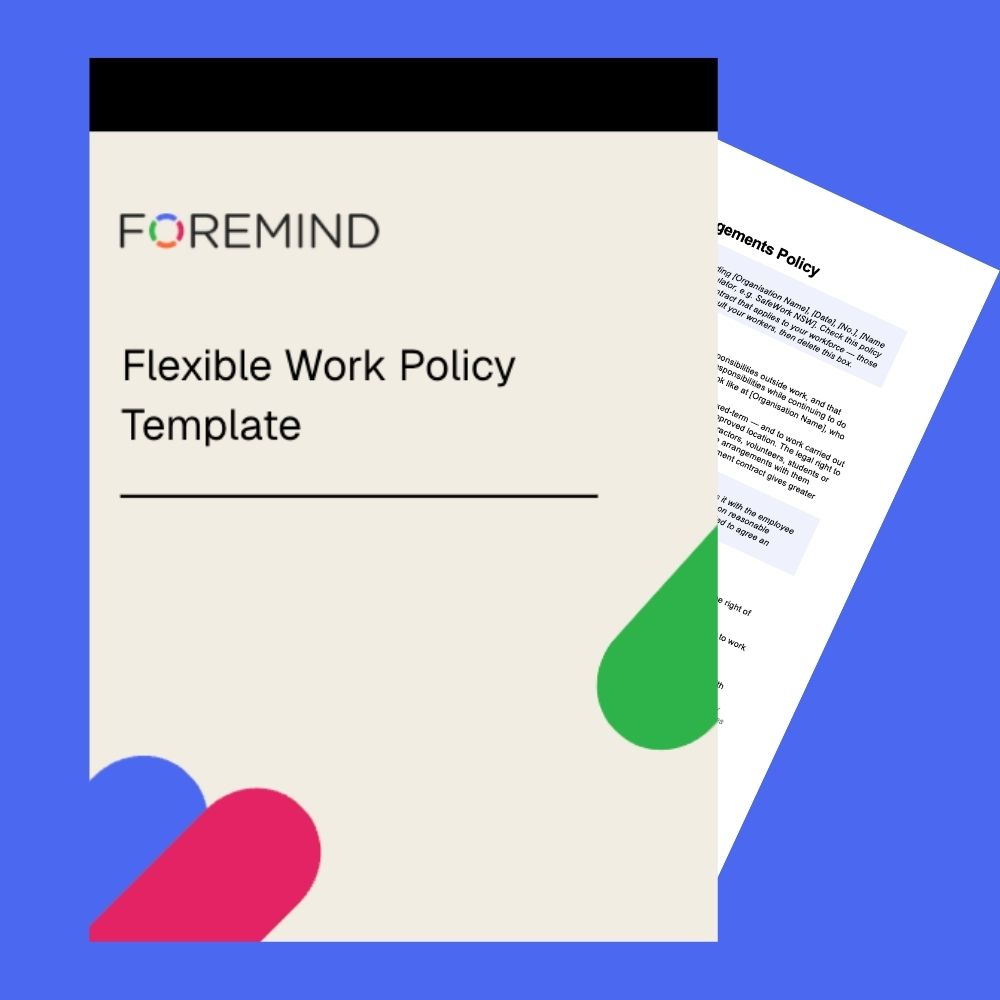
Flexible Working Arrangements Policy Template
What's in this template
A ready-to-customise Flexible Working Arrangements Policy for Australian employers, written for the national workplace relations system.
Twelve sections covering purpose and scope, the legislative framework, roles and responsibilities, the types of arrangements available, who has a right to request one, and how to make and respond to a request within the 21-day window.
It also covers work health and safety for off-site work, how to raise a concern, dispute resolution, support services, breaches, and review — plus a document control table and disclaimer.
Every item needing customisation is marked in square brackets.
How to use it
Replace everything in brackets — organisation name, contacts, EAP details, your regulator, your request form and grievance policy.
Check it against any award, enterprise agreement or contract covering your workforce. Where those give greater entitlements, they apply.
Consult your workers before you implement it. That's mandatory under WHS legislation, not a nice-to-have. Then have a qualified legal or WHS practitioner review it before it goes live.
Why it matters
Eligible employees have a legal right to request flexible work, and employers have obligations that come with it: discuss the request, genuinely try to reach agreement, and respond in writing within 21 days. A refusal has to rest on reasonable business grounds, and unresolved disputes can be referred to the Fair Work Commission.
Beyond compliance, flexible work is a psychosocial control. Poorly handled requests, inconsistent decisions and isolated remote workers all create risk. A written policy makes decisions consistent and defensible, and gives managers something to follow instead of improvising.
FAQs
Who can request flexible work?
Employees with at least 12 months' service who are a parent or carer of a school-aged or younger child, a carer under the Carer Recognition Act, pregnant, have a disability, are 55 or older, or are experiencing family and domestic violence or supporting someone who is. Casuals qualify if they've worked on a regular and systematic basis for 12 months with a reasonable expectation of continuing work.
Can we say no?
Only on reasonable business grounds — cost, impracticality, or significant loss of efficiency, productivity or customer service — and only after genuinely trying to agree an alternative. The written refusal must explain the grounds, offer any alternative you can, and set out how the employee escalates.
Does it cover working from home safety?
Yes. Section 7 covers workstation self-assessment, breaks and fatigue, hazard and incident reporting, confidentiality, and manager check-ins on workload and isolation. Your WHS duties apply wherever the work is done.
Do we have to consult staff?
Yes, before implementing or changing it. Consultation is a WHS requirement.
Is it ready to publish as-is?
No. It's a starting point. Customise it, check it against your award or agreement, and have it legally reviewed.

Hello 👋 I’m Joel the founder of Foremind.
Are you ready for simplified support & compliance?
Answers to the frequently asked questions.
Our last EAP was barely touched. Why would this be different?+
Most EAPs go unused because of how they're accessed, not because staff don't need them. Phoning a stranger, explaining yourself, then waiting weeks is enough to stop most people before they start. Foremind removes all three steps: staff see real counsellor profiles, pick someone themselves, and book the same day.
If you already have a provider, the question worth asking is what your current utilisation is. Most traditional EAPs sit in low single digits, which means you're paying for cover your people aren't reaching. If yours is being used, staff can get seen quickly, and it covers your psychosocial obligations, there's no reason to move. If not, it's worth knowing what you're getting for the spend.
Do you offer 24/7 support?+
Yes. A 24/7 after-hours crisis line means staff can reach someone immediately at any hour, including nights and weekends.
Counselling appointments are also available outside standard business hours, so shift-based and on-call teams aren't limited to a nine-to-five window. Those are two different things, and it's worth checking any provider offers both rather than just the crisis line.
Are your EAP counsellors based in Australia?+
Yes. Every practitioner on the platform holds current membership with an Australian professional body and practises under Australian standards, codes of ethics and disciplinary frameworks. There are no offshore call centres.
Practitioners hold membership with the Australian Counselling Association, the Psychotherapy and Counselling Federation of Australia, or the Australian Association of Social Workers, along with a current Working with Children or Vulnerable People Check.
How much does an EAP cost?+
Pricing is usually per employee per month, based on total headcount rather than how many people use the service. Costs vary widely depending on whether sessions are bundled in and whether compliance tooling is included.
A more useful comparison is cost per employee who actually uses it. An EAP with 2% utilisation can work out several times more expensive per person helped than one that gets used. Foremind offers pay-as-you-go, inclusive session plans and compliance-inclusive plans, with discounted pricing for not-for-profits and charities.
For full breakdown of our plans, see our EAP pricing page or request a quote for a tailored proposal.
What information does an employer receive about EAP usage?+
Nothing that could identify anyone. All counselling is completely confidential and all reporting is anonymous - you'll never see who booked, when, or what was discussed.
What you do see is the aggregated picture: how many people are using it, what psychosocial risks are prevalent in the business, and which teams are under pressure. Enough to know the investment is working and where to act, never enough to identify a person. Reporting thresholds mean small teams can't be reverse-engineered from the data.
Does having an EAP meet an employer's psychosocial duty of care?+
No. An EAP is a control measure, and a valuable one, but it only addresses harm after it has occurred. It doesn't identify hazards, assess risk, or evidence that controls are working.
Australian WHS law requires you to identify psychosocial hazards, assess the risk, control it so far as is reasonably practicable, and review whether those controls are working — with documented evidence at each step. Offering counselling on its own leaves three of those four steps undocumented.
Foremind covers both in one platform. See how the compliance side works in our product tour.