
Australian Mental Health & Wellbeing Calendar
Keep track of the key mental health and wellbeing dates across the year.


- Wellbeing calendars help HR teams schedule consistent workplace mental health initiatives year-round.
- Teams must prioritize April 28, September 10, and October for compliance planning.
- Awareness days drive cultural engagement, while psychosocial safety plans ensure legal compliance.
- Employers must legally control psychosocial hazards, using awareness dates to encourage reporting.
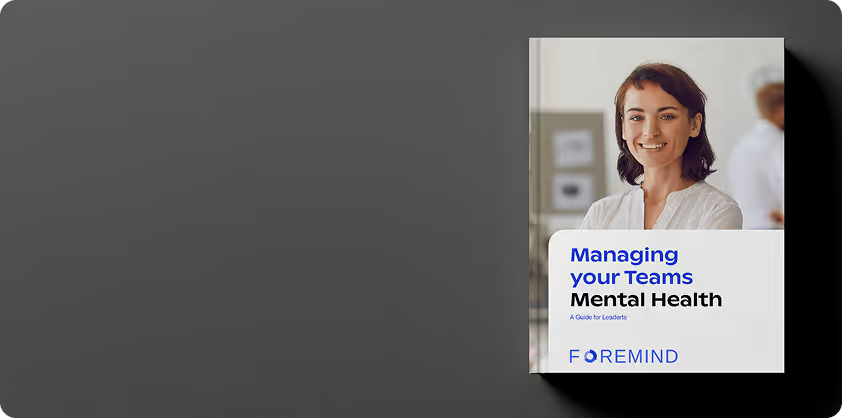
Download our guide to managing your teams mental health
A workplace mental health and wellbeing calendar is a planning tool that maps key Australian awareness dates, campaigns, and health observances across the year. For HR teams, people and culture leaders, and WHS officers, it provides a structured way to schedule wellbeing initiatives, open conversations with staff, and demonstrate a proactive commitment to psychosocial safety, not just once a year, but consistently.
The dates below are drawn from the 2026 Australian mental health observance schedule. Where a date carries specific relevance to psychosocial hazard compliance or employer obligations under the Work Health and Safety Act, that is noted alongside it.
Which awareness dates should HR and WHS teams prioritise?
HR and WHS teams should anchor their annual wellbeing planning around three dates above all others: World Day for Safety and Health at Work (28 April), R U OK? Day (10 September), and National Safe Work Month (October).
These three carry the strongest employer compliance relevance. World Day for Safety and Health at Work is the natural moment to conduct or review psychosocial risk assessments. R U OK? Day is the most effective activation point for manager training and EAP promotion.
National Safe Work Month, led by Safe Work Australia, provides a full month to communicate your organisation's safety obligations and initiatives to the entire workforce.
Beyond those three, any organisation with a significant male workforce should treat Men's Health Week and Movember as mandatory activation points, given the consistently low rate of help-seeking among male employees and the elevated risk of psychological injury in industries such as construction and transport.
How can managers use awareness days to open mental health conversations?
Awareness days give managers a socially sanctioned reason to start conversations they might otherwise avoid. The most effective approach is to use the awareness date as a prompt to check in, rather than to deliver information. A manager who says "It's R U OK? Day. I wanted to check in and see how you're actually going" opens a more genuine exchange than one who sends a link to a fact sheet.
For managers who want to build this skill, Foremind's psychosocial hazards training and education programs provide practical frameworks for having supportive conversations at work. Pairing this training with key awareness dates in the calendar creates a structured, repeatable approach rather than a one-off gesture.
What is the difference between a wellbeing calendar and a psychosocial safety plan?
A wellbeing calendar and a psychosocial safety plan serve different but complementary purposes. A wellbeing calendar is a communications and engagement tool, it maps awareness dates and gives teams a schedule for raising mental health conversations throughout the year. A psychosocial safety plan is a legal compliance document.
Under Australian WHS legislation, employers are required to identify, assess, and control psychosocial hazards in the workplace. That obligation exists independently of any awareness campaign.
The most effective organisations use both. The calendar creates the cultural conditions for open conversation. The psychosocial safety plan ensures the organisation is meeting its obligations and systematically reducing the risks that cause psychological harm. Foremind's psychosocial safety system is designed to support both.
What is National Safe Work Month?
National Safe Work Month is an annual campaign held every October and led by Safe Work Australia. It is the primary national initiative for raising awareness of workplace health and safety obligations across Australia. For employers, it is the strongest opportunity of the year to communicate WHS responsibilities to staff, review existing safety systems, and run training programs.
Since psychosocial hazards became a legislated focus across most Australian states and territories, National Safe Work Month has grown in relevance for HR, WHS, and people and culture teams who are working to meet their psychosocial hazards compliance obligations.
What is R U OK? Day?
R U OK? Day is an annual awareness day held on the second Thursday of September, falling on 10 September in 2026. It is led by the Australian charity R U OK? and encourages people to ask those around them whether they are coping. In a workplace context, R U OK? Day is widely used to promote manager check-ins, reduce mental health stigma, and signal that asking for help is accepted. It is most effective when paired with a clear communication about what support is available, including EAP counselling services employees can access confidentially.
What is World Mental Health Day?
World Mental Health Day is observed annually on 10 October and is coordinated by the World Federation for Mental Health. It is the highest-profile global mental health awareness date and is widely used by employers to communicate their commitment to employee psychological wellbeing. In 2026, World Mental Health Day falls within National Safe Work Month, making October the most important month in the year for employers to run wellbeing and psychosocial safety initiatives together.
Do employers have legal obligations around mental health awareness?
Employers do not have a specific legal obligation to mark mental health awareness dates, but they do have a legal obligation to proactively manage psychosocial hazards at work. Under the Model WHS Regulations, adopted across most Australian states and territories, employers must identify psychosocial hazards, assess the risks they pose, and implement controls to eliminate or minimise those risks. Awareness activities support this obligation by creating the cultural conditions for early identification and reporting of hazards.
How do I run a workplace wellbeing program around these dates?
An effective workplace wellbeing program uses awareness dates as activation points within a broader strategy rather than treating each date as a standalone event. The simplest structure is to assign a quarterly wellbeing focus, identify one or two anchor dates within that quarter, schedule a manager communication or team activity around those dates, and pair each activation with a clear prompt to access support through your EAP. For organisations that want a more structured approach,
Foremind helps Australian organisations build psychosocial safety systems that go beyond awareness campaigns. If you want to understand where your organisation sits on mental health and psychosocial safety, visit foremind.com.au to explore our platform, request a psychosocial risk assessment, or book a demo with our team.
Related

Answers to the frequently asked questions.
Our last EAP was barely touched. Why would this be different?+
Most EAPs go unused because of how they're accessed, not because staff don't need them. Phoning a stranger, explaining yourself, then waiting weeks is enough to stop most people before they start. Foremind removes all three steps: staff see real counsellor profiles, pick someone themselves, and book the same day.
If you already have a provider, the question worth asking is what your current utilisation is. Most traditional EAPs sit in low single digits, which means you're paying for cover your people aren't reaching. If yours is being used, staff can get seen quickly, and it covers your psychosocial obligations, there's no reason to move. If not, it's worth knowing what you're getting for the spend.
Do you offer 24/7 support?+
Yes. A 24/7 after-hours crisis line means staff can reach someone immediately at any hour, including nights and weekends.
Counselling appointments are also available outside standard business hours, so shift-based and on-call teams aren't limited to a nine-to-five window. Those are two different things, and it's worth checking any provider offers both rather than just the crisis line.
Are your EAP counsellors based in Australia?+
Yes. Every practitioner on the platform holds current membership with an Australian professional body and practises under Australian standards, codes of ethics and disciplinary frameworks. There are no offshore call centres.
Practitioners hold membership with the Australian Counselling Association, the Psychotherapy and Counselling Federation of Australia, or the Australian Association of Social Workers, along with a current Working with Children or Vulnerable People Check.
How much does an EAP cost?+
Pricing is usually per employee per month, based on total headcount rather than how many people use the service. Costs vary widely depending on whether sessions are bundled in and whether compliance tooling is included.
A more useful comparison is cost per employee who actually uses it. An EAP with 2% utilisation can work out several times more expensive per person helped than one that gets used. Foremind offers pay-as-you-go, inclusive session plans and compliance-inclusive plans, with discounted pricing for not-for-profits and charities.
For full breakdown of our plans, see our EAP pricing page or request a quote for a tailored proposal.
What information does an employer receive about EAP usage?+
Nothing that could identify anyone. All counselling is completely confidential and all reporting is anonymous - you'll never see who booked, when, or what was discussed.
What you do see is the aggregated picture: how many people are using it, what psychosocial risks are prevalent in the business, and which teams are under pressure. Enough to know the investment is working and where to act, never enough to identify a person. Reporting thresholds mean small teams can't be reverse-engineered from the data.
Does having an EAP meet an employer's psychosocial duty of care?+
No. An EAP is a control measure, and a valuable one, but it only addresses harm after it has occurred. It doesn't identify hazards, assess risk, or evidence that controls are working.
Australian WHS law requires you to identify psychosocial hazards, assess the risk, control it so far as is reasonably practicable, and review whether those controls are working — with documented evidence at each step. Offering counselling on its own leaves three of those four steps undocumented.
Foremind covers both in one platform. See how the compliance side works in our product tour.