
Is your small business falling behind on psychosocial safety?
Here’s what you need to know.


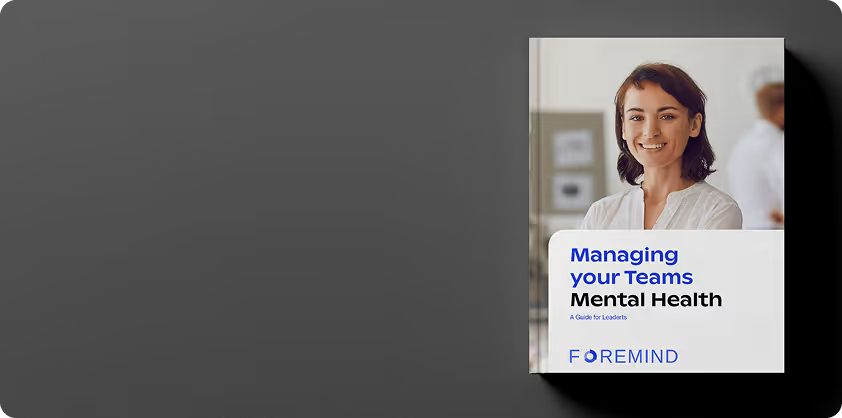
Download our guide to managing your teams mental health
If you run a small business in Australia, there is a good chance your team is one of the most important things that you have built.
In an article by the Australian Institute of Health and Safety it cited a national multidisciplinary study conducted by the Queensland University of Technology ( QUT) in 2025. The study found that small and micro sized businesses are significantly lagging behind when it comes to managing psychosocial hazards at work.
This poses significant risks in relation to compliance and the risks to the health and safety of workers.
The findings
The QUT led study surveyed 288 decision-makers across Australian small to medium enterprises (SMEs) and painted a troubling picture. Approximately one in five micro-business owners did not even know that they had legal obligations to manage psychosocial hazards.
More than half had no formal policies in place in relation to managing psychosocial hazards, and 44 per cent had never attempted to identify these risks in their workplace.
The pattern is evident. The smaller the business, the greater the gap in relation to awareness and taking action.
This matters because SMEs collectively employ 65 per cent of Australia’s workforce. That is why improving awareness and compliance is critical.
The legal exposure is apparent. Businesses that have not taken steps to identify or manage psychosocial risks are not only putting their people at risk, but they are also being exposed to regulatory penalties and civil liability.
Research conducted by QUT indicates that although there has been regulatory amendments in relation to psychosocial hazard management and Codes of Practice in place since 2021, many SMEs are not meeting their regulatory requirements.
Priority areas
The research team identified two priority areas in supporting SMEs compliance. Firstly, by creating practical and scalable resources for businesses that have limited time, resources and expertise. And designing targeted education programs that align with the context of micro-sized enterprises. Industry associations could also provide greater assistance in sharing resources and promoting good and best practice.
How Foremind Can Assist
This is exactly the gap that Foremind was built to address.
At Foremind, we believe that protecting your team’s mental health and wellbeing does not have to be complicated or costly. We work with small and medium-sized businesses to make psychosocial risk management practical, accessible and genuinely effective, without the enterprise tag. We are here to offer support and guidance along your psychosocial safety journey.
If you are unsure where your business stands, or you are aware of some gaps you have not yet addressed, now is the time to act.
If you would like to know more, feel free to reach out to the friendly Foremind team. We are here to make psychosocial safety simple, scalable and something that will benefit your entire team.
Authors: Langdon, Rebecca, Karanikas, Kektarios & Hon, Carol ( 2025) Psychological Hazard Management in Small to Medium-Sized Enterprises in Australia: Survey Findings to Inform Policy and Practice, Queensland University of Technology, Australia



Answers to the frequently asked questions.
Our last EAP was barely touched. Why would this be different?+
Most EAPs go unused because of how they're accessed, not because staff don't need them. Phoning a stranger, explaining yourself, then waiting weeks is enough to stop most people before they start. Foremind removes all three steps: staff see real counsellor profiles, pick someone themselves, and book the same day.
If you already have a provider, the question worth asking is what your current utilisation is. Most traditional EAPs sit in low single digits, which means you're paying for cover your people aren't reaching. If yours is being used, staff can get seen quickly, and it covers your psychosocial obligations, there's no reason to move. If not, it's worth knowing what you're getting for the spend.
Do you offer 24/7 support?+
Yes. A 24/7 after-hours crisis line means staff can reach someone immediately at any hour, including nights and weekends.
Counselling appointments are also available outside standard business hours, so shift-based and on-call teams aren't limited to a nine-to-five window. Those are two different things, and it's worth checking any provider offers both rather than just the crisis line.
Are your EAP counsellors based in Australia?+
Yes. Every practitioner on the platform holds current membership with an Australian professional body and practises under Australian standards, codes of ethics and disciplinary frameworks. There are no offshore call centres.
Practitioners hold membership with the Australian Counselling Association, the Psychotherapy and Counselling Federation of Australia, or the Australian Association of Social Workers, along with a current Working with Children or Vulnerable People Check.
How much does an EAP cost?+
Pricing is usually per employee per month, based on total headcount rather than how many people use the service. Costs vary widely depending on whether sessions are bundled in and whether compliance tooling is included.
A more useful comparison is cost per employee who actually uses it. An EAP with 2% utilisation can work out several times more expensive per person helped than one that gets used. Foremind offers pay-as-you-go, inclusive session plans and compliance-inclusive plans, with discounted pricing for not-for-profits and charities.
For full breakdown of our plans, see our EAP pricing page or request a quote for a tailored proposal.
What information does an employer receive about EAP usage?+
Nothing that could identify anyone. All counselling is completely confidential and all reporting is anonymous - you'll never see who booked, when, or what was discussed.
What you do see is the aggregated picture: how many people are using it, what psychosocial risks are prevalent in the business, and which teams are under pressure. Enough to know the investment is working and where to act, never enough to identify a person. Reporting thresholds mean small teams can't be reverse-engineered from the data.
Does having an EAP meet an employer's psychosocial duty of care?+
No. An EAP is a control measure, and a valuable one, but it only addresses harm after it has occurred. It doesn't identify hazards, assess risk, or evidence that controls are working.
Australian WHS law requires you to identify psychosocial hazards, assess the risk, control it so far as is reasonably practicable, and review whether those controls are working — with documented evidence at each step. Offering counselling on its own leaves three of those four steps undocumented.
Foremind covers both in one platform. See how the compliance side works in our product tour.