
Critical Incident Response Handbook
Learn how to respond effectively to critical incidents in your workplace.
What's in this guide
A practical guide for anyone who might take the first call — duty officers, line managers, wellbeing and HR leads.
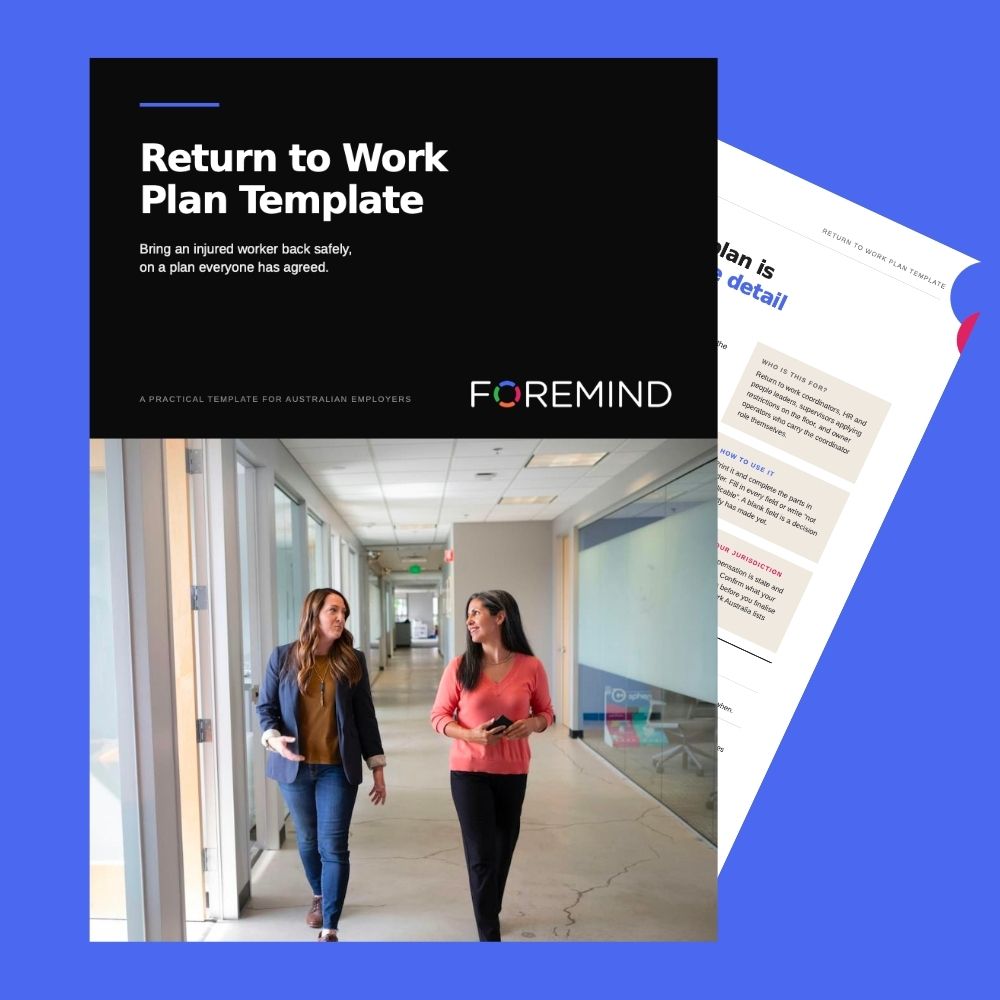
It covers how to tell an incident, an emergency, a critical incident and a crisis apart; the events that cross the threshold; and a six-step pathway — Control, Assess, Notify, Act, Document, Audit — that scales from ten minutes to several weeks.
Plus: the six things to capture before you hang up, who to notify and when, the order to work in when decisions compete, what to record, and a readiness checklist.
How to use it
Read it before an incident occurs. The worst time to work out your response pathway is while someone distressed is on the phone.
Share it with your leadership team as part of your psychosocial hazard controls. Make sure whoever answers the phone knows the six things to capture, who to notify, and to start writing it down. Then use the checklist to find your gaps.
Why it matters
Most organisations have a plan. Few have rehearsed the first ten minutes.
Whoever takes the first call sets the tone for everything after it. They don't need to be the clinical responder — they need to establish safety, capture the facts and activate support.
Victoria's OHS (Psychological Health) Regulations 2025 took effect on 1 December 2025, joining equivalent psychosocial regulations in every other state and territory. Exposure to a traumatic event is a psychosocial hazard. How you respond is one of your controls.
FAQs
What counts as a critical incident?
A workplace event that has caused, or could cause, substantial psychological distress or disruption. Serious injury, assault or threats, a death, fire or hazard, a child protection breach, or someone uncontactable. Context changes severity. If you're unsure, call rather than deliberate.
Is there a severity score to apply first?
No. Activate on the nature and psychological impact of the event, not a generic rating.
Is this just for high-risk industries?
No. The pathway applies anywhere a workplace event causes psychological harm.
What if I say the wrong thing?
You're not the clinical responder. The guide gives you a structure, not a script: six things to capture, a pause-and-recap habit, and what to say when you brief affected people.
Is the post-incident review a debrief for staff?
No. Both reviews examine how the incident was managed. Neither is a psychological debriefing, and no one is required to attend or recount the event.
Does a response plan satisfy our compliance obligations?
It's one control, not the whole thing. It doesn't replace systematic hazard management, your incident reporting policy or your crisis management plan.

Hello 👋 I’m Joel the founder of Foremind.
Are you ready for simplified support & compliance?
Answers to the frequently asked questions.
Our last EAP was barely touched. Why would this be different?+
Most EAPs go unused because of how they're accessed, not because staff don't need them. Phoning a stranger, explaining yourself, then waiting weeks is enough to stop most people before they start. Foremind removes all three steps: staff see real counsellor profiles, pick someone themselves, and book the same day.
If you already have a provider, the question worth asking is what your current utilisation is. Most traditional EAPs sit in low single digits, which means you're paying for cover your people aren't reaching. If yours is being used, staff can get seen quickly, and it covers your psychosocial obligations, there's no reason to move. If not, it's worth knowing what you're getting for the spend.
Do you offer 24/7 support?+
Yes. A 24/7 after-hours crisis line means staff can reach someone immediately at any hour, including nights and weekends.
Counselling appointments are also available outside standard business hours, so shift-based and on-call teams aren't limited to a nine-to-five window. Those are two different things, and it's worth checking any provider offers both rather than just the crisis line.
Are your EAP counsellors based in Australia?+
Yes. Every practitioner on the platform holds current membership with an Australian professional body and practises under Australian standards, codes of ethics and disciplinary frameworks. There are no offshore call centres.
Practitioners hold membership with the Australian Counselling Association, the Psychotherapy and Counselling Federation of Australia, or the Australian Association of Social Workers, along with a current Working with Children or Vulnerable People Check.
How much does an EAP cost?+
Pricing is usually per employee per month, based on total headcount rather than how many people use the service. Costs vary widely depending on whether sessions are bundled in and whether compliance tooling is included.
A more useful comparison is cost per employee who actually uses it. An EAP with 2% utilisation can work out several times more expensive per person helped than one that gets used. Foremind offers pay-as-you-go, inclusive session plans and compliance-inclusive plans, with discounted pricing for not-for-profits and charities.
For full breakdown of our plans, see our EAP pricing page or request a quote for a tailored proposal.
What information does an employer receive about EAP usage?+
Nothing that could identify anyone. All counselling is completely confidential and all reporting is anonymous - you'll never see who booked, when, or what was discussed.
What you do see is the aggregated picture: how many people are using it, what psychosocial risks are prevalent in the business, and which teams are under pressure. Enough to know the investment is working and where to act, never enough to identify a person. Reporting thresholds mean small teams can't be reverse-engineered from the data.
Does having an EAP meet an employer's psychosocial duty of care?+
No. An EAP is a control measure, and a valuable one, but it only addresses harm after it has occurred. It doesn't identify hazards, assess risk, or evidence that controls are working.
Australian WHS law requires you to identify psychosocial hazards, assess the risk, control it so far as is reasonably practicable, and review whether those controls are working — with documented evidence at each step. Offering counselling on its own leaves three of those four steps undocumented.
Foremind covers both in one platform. See how the compliance side works in our product tour.