
Foremind Partners with JWLand
Foremind partners with JWLand to deliver mental health support for construction.


Download our guide to managing your teams mental health
Foremind is proud to partner with JWLand to pioneer a mental health initiative by two local Canberra companies
Foremind is proud to announce our partnership with Canberra-based development company JWLand, to introduce a comprehensive mental health program for construction workers.
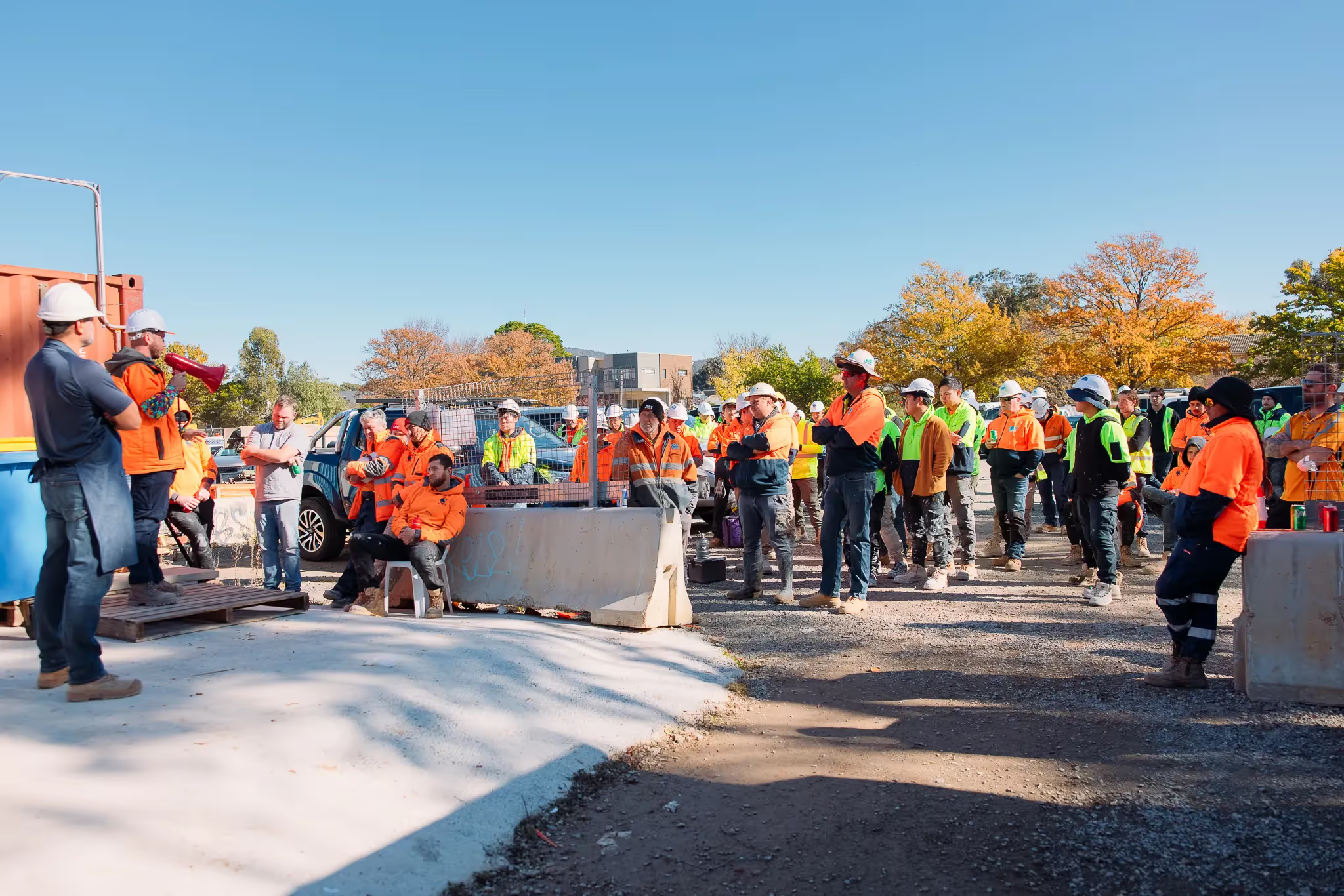
The initiative was launched at JWLand’s Northbourne Village development site on Friday the 19th of May. Director of Construction, Aaron Ackland, says the addition of Foremind’s program to the company’sexisting systems is a response to the pressures workers experience in the construction industry. Ackland says he was shocked to discover that construction workers are six times more likely to die from suicide than a workplace injury and that, in Australia, a worker dies by suicide every two days.
That suicide rate is 80 per cent higher than for the population as a whole.
“Construction work has its own physical and mental challenges. For example, a six-day working week if not appropriately managed can have an impact on relationships and overall well-being,” Ackland said.
He says JWLand has already set up a service, through the company’s own HR department, to offer psychological support should staff require it. Now the Foremind program will enhance that support and extend a level of service to its subcontractors on their construction sites.
The program aims to put a mental health resource in every worker’s pocket. Foremind offers steps bywhich the worker can engage with assistance, either through online resources or directly with acounsellor by phone, online or face-to-face. The initial service is completely confidential andoperates at no cost to workers.
The initiative was launched at the Northbourne site during a toolbox talk that included a BBQ for all members of the project, including subbies.
CEO of Foremind, Joel Anderson, emphasises that all his company’s counsellors have experience in the sector and that all programs are specifically tailored for these workers. Anderson himself previously worked in construction and engineering and has had his own struggles with mental health in the past.
“In industries like mining, transport and construction, the culture has a bit of a reputation for being blokey and just urging people to have a cup of concrete and harden up,” Anderson says.
“What typically happens is that workers won’t admit they have a problem until they’re at crisis point. Our program makes it easier for them to get help before that happens.”
We are proud to partner with JWLand as our first first commercial partner in our home city.
Find out more about how we are improving mental health for workers and supporting companies manage their Psychosocial Hazard compliance!




Answers to the frequently asked questions.
Our last EAP was barely touched. Why would this be different?+
Most EAPs go unused because of how they're accessed, not because staff don't need them. Phoning a stranger, explaining yourself, then waiting weeks is enough to stop most people before they start. Foremind removes all three steps: staff see real counsellor profiles, pick someone themselves, and book the same day.
If you already have a provider, the question worth asking is what your current utilisation is. Most traditional EAPs sit in low single digits, which means you're paying for cover your people aren't reaching. If yours is being used, staff can get seen quickly, and it covers your psychosocial obligations, there's no reason to move. If not, it's worth knowing what you're getting for the spend.
Do you offer 24/7 support?+
Yes. A 24/7 after-hours crisis line means staff can reach someone immediately at any hour, including nights and weekends.
Counselling appointments are also available outside standard business hours, so shift-based and on-call teams aren't limited to a nine-to-five window. Those are two different things, and it's worth checking any provider offers both rather than just the crisis line.
Are your EAP counsellors based in Australia?+
Yes. Every practitioner on the platform holds current membership with an Australian professional body and practises under Australian standards, codes of ethics and disciplinary frameworks. There are no offshore call centres.
Practitioners hold membership with the Australian Counselling Association, the Psychotherapy and Counselling Federation of Australia, or the Australian Association of Social Workers, along with a current Working with Children or Vulnerable People Check.
How much does an EAP cost?+
Pricing is usually per employee per month, based on total headcount rather than how many people use the service. Costs vary widely depending on whether sessions are bundled in and whether compliance tooling is included.
A more useful comparison is cost per employee who actually uses it. An EAP with 2% utilisation can work out several times more expensive per person helped than one that gets used. Foremind offers pay-as-you-go, inclusive session plans and compliance-inclusive plans, with discounted pricing for not-for-profits and charities.
For full breakdown of our plans, see our EAP pricing page or request a quote for a tailored proposal.
What information does an employer receive about EAP usage?+
Nothing that could identify anyone. All counselling is completely confidential and all reporting is anonymous - you'll never see who booked, when, or what was discussed.
What you do see is the aggregated picture: how many people are using it, what psychosocial risks are prevalent in the business, and which teams are under pressure. Enough to know the investment is working and where to act, never enough to identify a person. Reporting thresholds mean small teams can't be reverse-engineered from the data.
Does having an EAP meet an employer's psychosocial duty of care?+
No. An EAP is a control measure, and a valuable one, but it only addresses harm after it has occurred. It doesn't identify hazards, assess risk, or evidence that controls are working.
Australian WHS law requires you to identify psychosocial hazards, assess the risk, control it so far as is reasonably practicable, and review whether those controls are working — with documented evidence at each step. Offering counselling on its own leaves three of those four steps undocumented.
Foremind covers both in one platform. See how the compliance side works in our product tour.