
Why Anonymous Reporting Matters More Than Ever
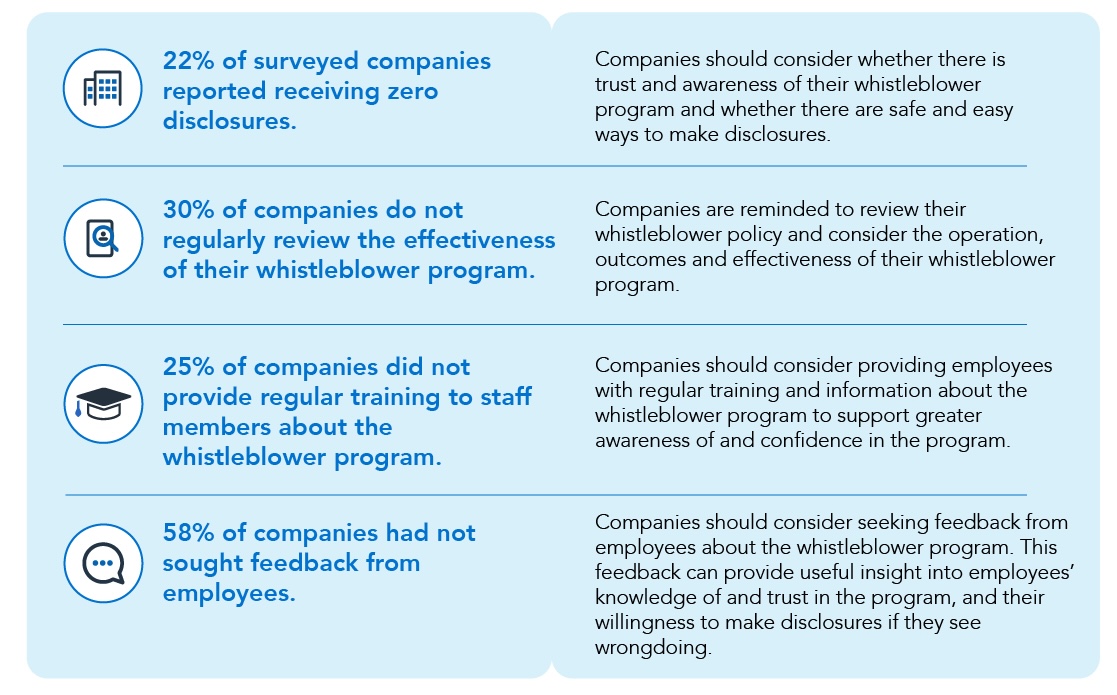
ASIC has released groundbreaking findings that should concern every business leader in Australia. Their first-ever comprehensive review of whistleblower programs across 134 companies has revealed significant gaps in protections.


Download our guide to managing your teams mental health
The Uncomfortable Truth About Speaking Up
ASIC Commissioner Alan Kirkland put it plainly: "Without effective policies and programs to encourage whistleblowers to come forward, misconduct may otherwise go unreported and undetected."
The numbers from ASIC's review paint a stark picture:
- 22% of companies received zero whistleblower disclosures – suggesting employees either don't trust the system or don't know how to use it
- Over one-third lack dedicated reporting channels for whistleblowers to raise concerns
- More than half haven't sought employee feedback on their whistleblower programs in the past year
- A quarter provide no regular training on whistleblowing processes
Perhaps most revealing: when companies do have effective programmes, they receive an average of 60 disclosures per year, with 24% of investigated cases being substantiated. This isn't just about compliance – it's about uncovering real issues that impact your people and your business.
The Connection to Psychosocial Hazards
Here's what ASIC's report implicitly highlights but many organisations miss: whistleblowing isn't just about financial misconduct or regulatory breaches. It's one of your most powerful early warning systems for identifying psychosocial hazards in your workplace.
Psychosocial hazards – workplace conditions that can cause psychological or physical harm – are notoriously difficult to detect through traditional channels. Employees experiencing or witnessing bullying, harassment, excessive workload demands, poor support systems, or toxic leadership often remain silent due to fear of retaliation, skepticism about confidentiality, or belief that nothing will change.
ASIC's findings underscore a critical truth: people won't report what they don't feel safe reporting. And when it comes to psychosocial hazards, the stakes are particularly high:
- The person experiencing the hazard may also be the person who needs to report it
- Power imbalances make speaking up especially risky
- Many psychosocial issues involve interpersonal dynamics where identities can be easily inferred
- The evidence is often subjective or behavioural, requiring multiple reports to establish patterns
This is precisely why Commissioner Kirkland emphasized the importance of "enabling communication with anonymous disclosers" as a key action companies should take.
Why Anonymity Isn't Optional – It's Essential
Traditional whistleblowing channels often fall short when it comes to psychosocial hazards. When someone needs to report their manager's bullying behaviour, a named complaint through HR can feel impossible. When a team witnesses discrimination but fears being identified, they stay silent. When workplace stress is causing mental health impacts but speaking up might label someone as "not coping," the issue goes unreported.
Anonymous reporting changes this equation fundamentally. It allows employees to:
- Report sensitive issues without fear of identification or retaliation
- Provide early warnings about developing problems before they escalate
- Share observations about team dynamics that would be impossible to raise openly
- Highlight systemic issues that affect multiple people but that no single person feels safe addressing
ASIC's data supports this: companies with mature whistleblower programmes – including those that enable anonymous reporting – receive significantly more disclosures and are better positioned to address issues before they cause serious harm.
How Foremind Addresses These Critical Gaps
At Foremind, we've built our platform specifically to address the challenges ASIC has identified – with a particular focus on creating safe channels for identifying and addressing psychosocial hazards.
Anonymous Reporting That Actually Works
Our anonymous reporting system goes beyond basic anonymity. We enable:
- True anonymity with two-way communication: Unlike simple anonymous submission forms, Foremind allows ongoing dialogue between reporters and your response team without ever compromising identity
- Psychosocial hazard identification: Purpose-built reporting pathways specifically designed for workplace stress, bullying, harassment, and other psychological safety concerns
- Pattern recognition: Aggregate anonymous data to identify systemic issues and emerging trends across your organisation
- Accessible channels: Multiple entry points for reporting that meet employees where they are, addressing ASIC's concern that over a third of companies lack dedicated reporting platforms
Building Trust Through Transparency
ASIC found that 58% of companies hadn't sought employee feedback on their whistleblower programmes. Foremind tackles this by:
- Providing visibility into how reports are handled and resolved (without compromising confidentiality)
- Enabling feedback loops that help employees see that reports lead to action
- Creating transparency around your commitment to psychological safety
Fostering a Speak-Up Culture for Wellbeing
The ASIC report emphasises "fostering a stronger speak-up culture" as essential to effective whistleblower programmes. For psychosocial hazards, this culture shift is even more critical. Foremind helps you:
- Normalise conversations about workplace wellbeing and psychological safety
- Encourage early reporting before situations escalate
- Demonstrate organisational commitment to addressing people-focused concerns
- Create safe feedback mechanisms that build trust over time
The Business Case Is Clear
ASIC's review found that 42% of companies that investigated substantiated disclosures took disciplinary action as the most common outcome. But here's what matters more: those investigations identified real issues causing real harm.
For psychosocial hazards specifically:
- Early detection prevents escalation: A single anonymous report about team stress can prevent future workers' compensation claims, turnover, and productivity loss
- Legal compliance: Work health and safety legislation now explicitly requires organisations to identify and manage psychosocial hazards
- Cultural intelligence: Anonymous reporting provides honest feedback about your workplace culture that you won't get through employee surveys or exit interviews
What You Should Do Now
ASIC Commissioner Kirkland encouraged companies to "benchmark themselves against the findings of the report and consider how they can improve their own whistleblower policies and practices."
Start by asking yourself:
- If an employee witnessed bullying tomorrow, would they know how to report it anonymously?
- Can your current system enable ongoing communication with anonymous reporters?
- Do you have mechanisms specifically designed to capture psychosocial hazard concerns?
- Would your employees trust that anonymous reports actually remain anonymous?
If you answered "no" or "I'm not sure" to any of these questions, it's time to strengthen your approach.
The Path Forward
ASIC's comprehensive review confirms what forward-thinking organisations already know: effective whistleblowing programmes – particularly those that enable true anonymous reporting – are fundamental to good governance and workplace safety.
For psychosocial hazards, which represent one of the most significant and fastest-growing areas of workplace risk, anonymous reporting isn't just a nice-to-have. It's the difference between identifying issues early and discovering them only after someone is seriously harmed.
The question isn't whether to implement robust anonymous reporting systems. The question is how quickly you can get them in place.
Ready to strengthen your approach to psychosocial hazard identification? Learn how Foremind's anonymous reporting platform can help your organisation create safer, healthier workplaces while meeting the standards ASIC expects from Australian companies.
Contact us today to see how our platform addresses the gaps identified in ASIC's groundbreaking review.

Answers to the frequently asked questions.
Our last EAP was barely touched. Why would this be different?+
Most EAPs go unused because of how they're accessed, not because staff don't need them. Phoning a stranger, explaining yourself, then waiting weeks is enough to stop most people before they start. Foremind removes all three steps: staff see real counsellor profiles, pick someone themselves, and book the same day.
If you already have a provider, the question worth asking is what your current utilisation is. Most traditional EAPs sit in low single digits, which means you're paying for cover your people aren't reaching. If yours is being used, staff can get seen quickly, and it covers your psychosocial obligations, there's no reason to move. If not, it's worth knowing what you're getting for the spend.
Do you offer 24/7 support?+
Yes. A 24/7 after-hours crisis line means staff can reach someone immediately at any hour, including nights and weekends.
Counselling appointments are also available outside standard business hours, so shift-based and on-call teams aren't limited to a nine-to-five window. Those are two different things, and it's worth checking any provider offers both rather than just the crisis line.
Are your EAP counsellors based in Australia?+
Yes. Every practitioner on the platform holds current membership with an Australian professional body and practises under Australian standards, codes of ethics and disciplinary frameworks. There are no offshore call centres.
Practitioners hold membership with the Australian Counselling Association, the Psychotherapy and Counselling Federation of Australia, or the Australian Association of Social Workers, along with a current Working with Children or Vulnerable People Check.
How much does an EAP cost?+
Pricing is usually per employee per month, based on total headcount rather than how many people use the service. Costs vary widely depending on whether sessions are bundled in and whether compliance tooling is included.
A more useful comparison is cost per employee who actually uses it. An EAP with 2% utilisation can work out several times more expensive per person helped than one that gets used. Foremind offers pay-as-you-go, inclusive session plans and compliance-inclusive plans, with discounted pricing for not-for-profits and charities.
For full breakdown of our plans, see our EAP pricing page or request a quote for a tailored proposal.
What information does an employer receive about EAP usage?+
Nothing that could identify anyone. All counselling is completely confidential and all reporting is anonymous - you'll never see who booked, when, or what was discussed.
What you do see is the aggregated picture: how many people are using it, what psychosocial risks are prevalent in the business, and which teams are under pressure. Enough to know the investment is working and where to act, never enough to identify a person. Reporting thresholds mean small teams can't be reverse-engineered from the data.
Does having an EAP meet an employer's psychosocial duty of care?+
No. An EAP is a control measure, and a valuable one, but it only addresses harm after it has occurred. It doesn't identify hazards, assess risk, or evidence that controls are working.
Australian WHS law requires you to identify psychosocial hazards, assess the risk, control it so far as is reasonably practicable, and review whether those controls are working — with documented evidence at each step. Offering counselling on its own leaves three of those four steps undocumented.
Foremind covers both in one platform. See how the compliance side works in our product tour.